Monster Stencil Font: Rugged Display Type for Handmade Brands
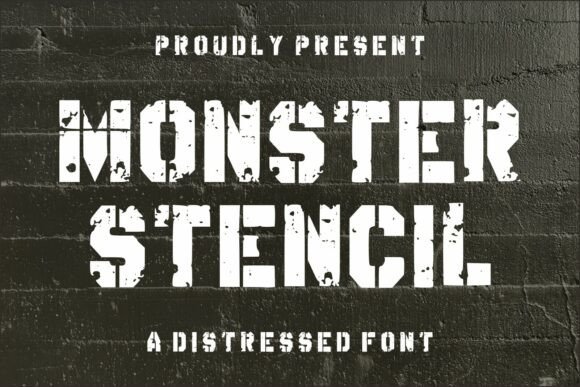
If you’ve ever held a hand-stamped metal tag, run your fingers over weathered barn wood lettering, or admired the raw honesty of a workshop stencil—then Monster Stencil will feel instantly familiar. This isn’t just another distressed font. It’s a display typeface built for makers who value texture, authenticity, and tactile appeal in their physical products. Designed with intentional gaps, uneven edges, and that unmistakable “cut-and-press” character, Monster Stencil delivers industrial charm without sacrificing readability—a rare balance I’ve learned to cherish when designing for real-world use.
I use Monster Stencil across nearly every product line in my small shop—from candle labels and boutique gift tags to printable wall art and wedding welcome signs. Its strength lies in how it holds up at different sizes and materials. At 24pt on a kraft paper sticker? Crisp and confident. At 120pt as a laser-cut wooden sign? Bold, grounded, and full of presence. Even at smaller sizes (10–14pt), the open counters and sturdy proportions keep it legible on product packaging—something I tested repeatedly on matte-finish soap labels and linen tea bag tags.
What makes Monster Stencil especially practical for crafters is its intentional restraint. Unlike some overly grungy fonts that blur into illegibility, Monster Stencil keeps letterforms distinct and well-spaced. That means cleaner cuts on Cricut and Silhouette machines—even with intricate inner details like the “e” or “a.” I’ve cut it from vinyl, iron-on, and chipboard without needing excessive node adjustments or manual cleanup. For SVG creators, the clean vector paths translate reliably across platforms, whether you’re bundling digital downloads or prepping layered templates for Canva users.
Think about where this font shines most: short, high-impact phrases. “Small Batch,” “Hand-Poured,” “Est. 2021,” “Farmhouse Fresh”—these aren’t just words; they’re brand signals. Monster Stencil turns them into visual anchors. On a ceramic mug? It reads like it belongs there—no digital gloss, no sterile perfection. On a seasonal greeting card for Halloween or rustic Christmas packaging? It adds warmth and intention, not gimmickry. I even used it for a set of printable planner stickers labeled “Grind,” “Grow,” and “Grit”—and customers specifically mentioned how the font reinforced the theme’s grounded energy.
For wedding stationery, Monster Stencil works beautifully as a secondary display font—not for full invitations (stick with a clean serif or soft script there), but for signage: welcome boards, bar menus, seating charts, and acrylic table numbers. Paired with a delicate handwritten font for names and a neutral sans serif for body text, it creates hierarchy without competing. Same goes for boutique retail: use it for shelf talkers, branded tape seals, or woven fabric tags. It communicates craftsmanship before the customer even reads a word.
Pairing Monster Stencil thoughtfully is key. I often combine it with a relaxed script font—like a natural chalk-style or modest brush script—for contrast that feels organic, not forced. For modern farmhouse or industrial brands, pair it with a warm, low-contrast sans serif (think Montserrat Light or Lato Regular) to ground the look. Avoid pairing it with other distressed or overly decorative fonts—that dilutes its impact. And while Monster Stencil itself is a display font (not meant for paragraphs), its clarity makes it surprisingly versatile for short headings in digital printables: planner headers, habit tracker titles, printable quote cards, and social media story templates.
Before downloading, check what’s included. Most quality versions of Monster Stencil come with both uppercase and lowercase glyphs, standard punctuation, and often stylistic alternates—like a more rugged “R” or simplified “G”—that let you fine-tune tone. Some include basic ligatures for smoother “fi” or “fl” connections, which matter more than you’d think on engraved wood or etched glass. File formats usually cover OTF and TTF, compatible with Silhouette Studio, Cricut Design Space, Adobe Creative Cloud, and free tools like Inkscape or Canva. If your audience includes international buyers, verify multilingual support—especially for common European accents, since many craft sellers ship globally.
Here’s what I always remind fellow sellers: Commercial licensing matters. Monster Stencil is a premium font—and if you’re using it in templates, SVG bundles, printable planners, or physical goods you sell (mugs, shirts, tote bags), make sure your license explicitly covers commercial use. Not all free or “personal use only” fonts allow resale of derivative designs. A properly licensed version protects your shop, ensures consistent file delivery to customers, and respects the designer’s work—something we all care about as makers.
In practice, Monster Stencil has become my go-to for projects where I want customers to *feel* the care behind the making—not just see it. It doesn’t shout. It stands. Whether it’s stamped on leather, printed on recycled cardstock, or cut from birch plywood, it carries weight without heaviness. It’s the kind of font that makes a $5 product feel intentional, a $30 sign feel heirloom-worthy, and a digital download feel like a thoughtful tool—not just decoration.
If your brand leans into authenticity, durability, or handmade grit, Monster Stencil isn’t just a design choice—it’s a quiet reinforcement of your values. And in a marketplace crowded with polished perfection, that kind of honest typography? That’s what makes people pause, remember, and reach for your product instead of the next one.